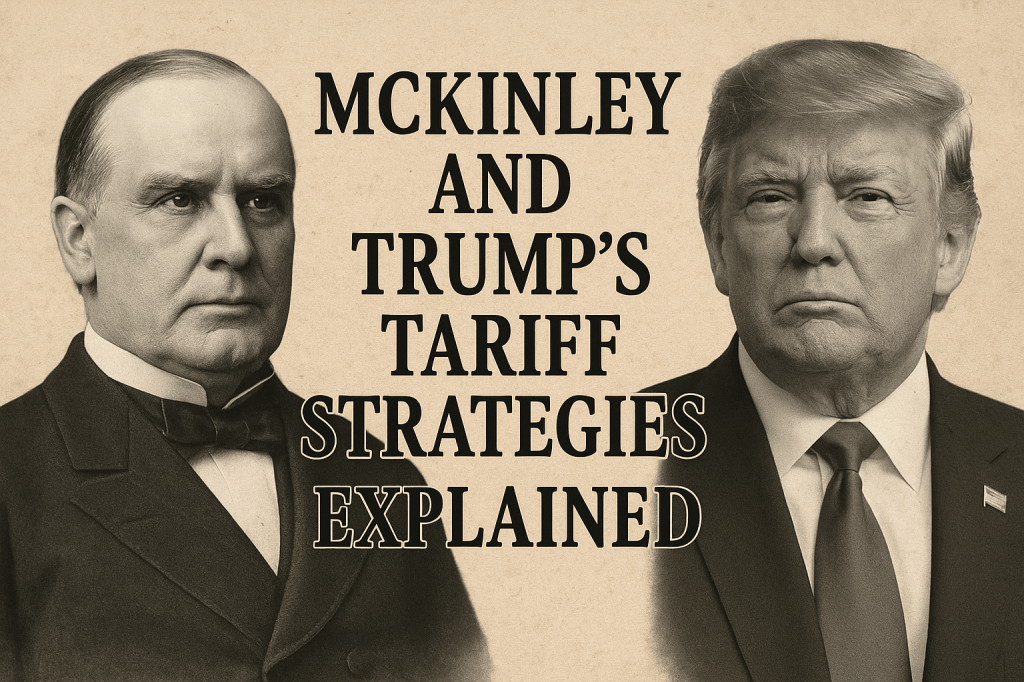
Tariffs are an economic policy meant to protect domestic production by making imports more expensive. The government makes foreign goods more expensive compared to domestic products by imposing a tax on imports. On highly commoditized industries (which means consumers only look for the lowest price), tariffs can make imports less competitive. In theory, this will boost domestic production. Domestic products will not have to pay the tariff; thus, they have an advantage over imports. However, tariff policies are linked to increased prices because these policies make cheaper foreign alternatives more expensive.
Analysis of President McKinley’s Tariff Policies
President Trump dubbed former U.S. President William McKinley, the “tariff king”. President McKinley was a U.S. president in the late 19th century who also utilized tariffs. Looking back at the effects of President McKinley’s tariffs, consumer prices rose in the industries affected by the tariffs. This is almost inevitable as less competition will yield higher prices.
When looking at U.S. manufacturing, the U.S. percent of global manufacturing did rise for 23% in 1870 to 36% in 1913. This does suggest that the tariffs has some positive effects. This growth can’t be directly tied to the tariffs, but it can’t be ignored either. The tariffs increased prices, making domestic production more competitive and lucrative. President McKinley’s policies were unfavorable at the time due to increased inflation. Despite this, they may have had an overall positive effect in the long-term. Because of the implied success of these tariff policies, President Trump is seeking to enact similar tariffs.
Analysis of President Trump’s Tariff Policies
Whitehouse.gov suggested that during President Trump’s second term, inflation has dropped to an average of 2.7%. The most common way to measure inflation in the U.S. is utilizing the Consumer Price Index (CPI). The Bureau of Labor Statistics reports very similar numbers to what President Trump is reporting as well. This suggests that President Trump’s tariff policies are not causing high inflation.
While historically a 2.7% inflation rate is high, it is significantly lower than the inflation rates the last few years. Inflation was high in recent years primarily because the Federal Funds Rate was so low. As a result, taking on debt was very cheap. When this happens, inflation tends to rise. Interest rates remained low for a long time to combat the COVID-19 recession effects. Consequently, inflation surged during most of President Biden’s term.
The Federal Funds Rate has now been raised. This means that inflation should slow down. However, the U.S. economy hit 3% inflation in June of 2023, and we have been around that rate for a while now. Inflation has not fallen lower in part due to these tariffs. Inflation is not necessarily a bad thing, especially if wages keep up with the rising costs. Real wages increased about 1.1% from August 2024 to August 2025. Real wages measures wage growth that results in higher purchasing power. This suggests that the economy is actually performing well. If these tariff policies are able to increase domestic investment and production, real wages will rise even higher. This is ultimately the goal of President Trump’s tariff policies. Incur a little bit of inflation to increase domestic production. Time will tell if his tariff policies can stay economically positive in the long-term.






Leave a reply to Trump’s Economic Claims at McDonald’s Impact Summit – Econified Cancel reply