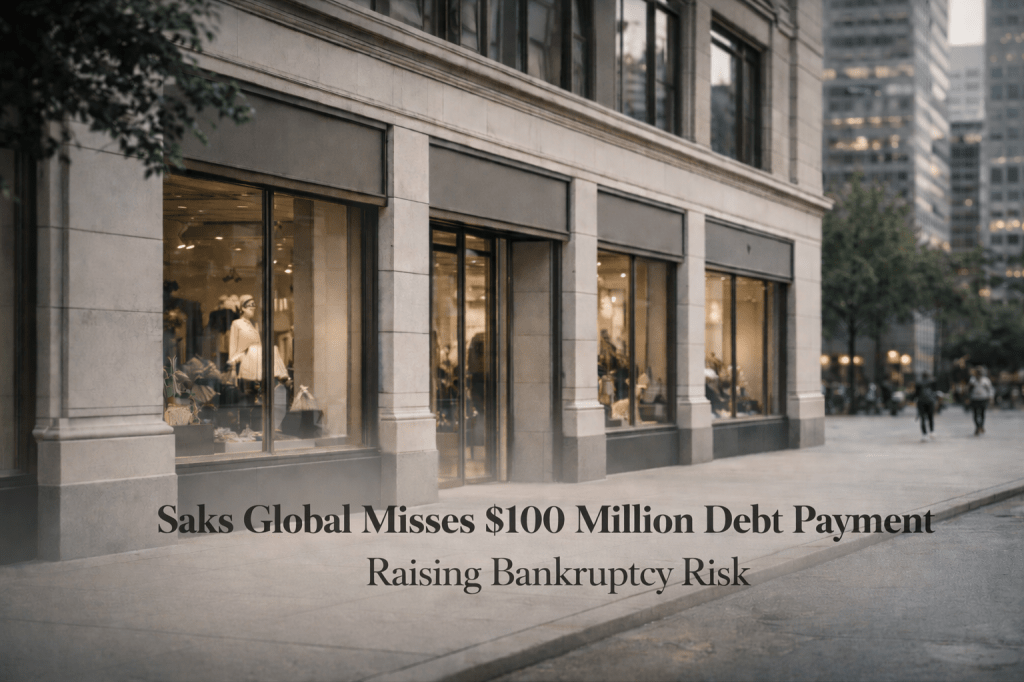
Saks Global is facing increased financial scrutiny after missing a roughly $100 million debt payment yesterday. Saks Global is a major company in the luxury retail space, operating high-end department stores and digital platforms, including Saks Fifth Avenue. Recently, Saks Global expanded its footprint through the acquisition of Neiman Marcus. According to Saks Global’s official website, the company describes itself as the “largest multi-brand luxury retailer in the world.”
News of a potential bankruptcy is highlighting broader concerns facing the retail market today. While Saks Global is privately held and does not publicly disclose detailed financial statements, they do utilize public bond markets to fund a lot of their debt. Additionally, recent creditor actions have given insight into Saks Global’s financial position. Other retailers operating in adjacent luxury segments, including SSENSE and Hudson’s Bay, also declared bankruptcy in 2025. Hudson’s Bay filed for bankruptcy in March 2025, bringing an end to the 355-year-old company, the oldest in North America. Both Hudson’s Bay and Saks Global have been owned by the same private equity firm, NRDC Equity Partners.
What Happened
Saks Global failed to make an approximately $100 million interest payment due to creditors on December 30. While the company has not yet formally filed for bankruptcy, missing a scheduled payment is a significant warning sign. Unless the debt can be paid quickly or restructured with creditors, a bankruptcy filing is more likely.
Importantly, this missed payment does not suggest that Saks Global is not worth $100 million. Saks Global’s valuation is private, but the large luxury retailer is generally understood to have a valuation in the billions. Rather, this default on the debt indicates a liquidity issue. The company did not have sufficient cash that was accessible at the required time to pay the interest on their debt. Liquidity shortfalls can arise from multiple factors, including lower revenues, costs, or cash restrictions tied to existing agreements or obligations.
Missing a debt payment has very negative consequences for an organization. Defaulting on debt raises future borrowing costs if financing is even offered at all. Many investors will not want to help finance any activity for a company that has defaulted before because the risk is too great. Because of the negative implications of a default on debt, swift action is required to keep the organization from bankruptcy.
Financial Pressures
Saks Global’s financial strain can be tied to its acquisition of Neiman Marcus in late 2024 for approximately $2.7 billion. While the deal significantly expanded Saks Global’s scale and market presence, it occurred at a time when financing conditions were tightening. Late 2024 saw some of the highest interest rates in the last 20 years which made the cost of this acquisition significant.
Not only was the debt expensive, but Neiman Marcus has also faced its own financial challenges in recent years. In 2020, Neiman Marcus filed for bankruptcy and had to restructure roughly $4 billion of debt before continuing operations. At the time of its sale, Neiman Marcus was owned by private equity, and its valuation was determined through private negotiations rather than public markets. As a result, the acquisition price may not have fully reflected ongoing revenue and margin pressures within the business.
Even prior to the Neiman Marcus transaction, Saks Global was managing a substantial debt load. To finance the acquisition, the company relied partly on investor capital but also issued approximately $2.2 billion in senior secured notes. This increased the firm’s fixed obligations as it would have to pay back this considerable debt.
Debt Restructuring
Those financial pressures eventually forced Saks Global to renegotiate its capital structure. In August, Saks Global restructured its $2.2 billion in senior secured notes through an exchange with their creditors. Creditors agreed to swap the $2.2 billion debt for $162.5 million in special purpose vehicle (SPV) notes. What this means is that Saks Global negotiated with their creditors because they were not in a position to pay back this debt. Creditors took a loss after determining that full repayment of the $2.2 billion was unlikely under existing conditions, but the $162.5 million is more assured because it is tied to specific assets. This transaction represented a significant reduction in debt. Rather than being repaid in full, creditors accepted smaller, more secure claims. Such exchanges are typically associated with heightened financial stress and limited refinancing options, so creditors are willing to take a loss to get more security.
While the restructuring reduced immediate debt pressure, it also indicated limited faith in the company’s ability to service obligations under its prior capital structure. As a result, any additional borrowing became substantially more expensive. This pressure has been compounded by the market interest rates. Although rates have begun to decline in 2025, high debt costs only further Saks Global’s debt issues. Higher interest expenses increase fixed costs, making sustained gross profit and consistent cash flow critical.
Consumer Spending and Luxury Retail Demand
Luxury retailers typically benefit from strong gross profit margins, as their customers are less price sensitive and luxury products command premium pricing. However, these advantages can quickly erode when sales volumes decline. Luxury retailers face high inventory costs, as premium brands wholesale goods at elevated prices. This requires consistent consumer discretionary spending to maintain healthy cash flow. When consumer demand softens, inventory risk rises, and unsold goods weigh on margins.
In addition, luxury department stores operate with high fixed costs. Premium locations, expansive retail footprints, higher-paid staff, and elevated operating standards all contribute to substantial overhead costs. When revenue declines, these fixed costs become increasingly difficult to absorb.
Recent reporting has highlighted declining consumer demand for luxury goods, placing pressure on luxury goods brands and luxury retailers. This means that the discretionary spending being utilized in this sector of the economy is decreasing. With high fixed costs and new debt, Saks Global is struggling to pay debtors and remain viable.
Broader Implications for Retail and Real Estate
Saks Global’s financial difficulties reflect broader challenges within luxury retail. While company-specific decisions contributed to current pressures, the sector as a whole is undergoing structural change. Many luxury brands are increasingly prioritizing direct-to-consumer (DTC) sales, which offer higher margins and greater control over branding. As a result, traditional department stores and other luxury retailers are less important for this industry.
If large luxury department stores reduce their physical footprints or exit markets entirely, commercial real estate will be affected. These stores often anchor malls and high-end shopping districts, driving foot traffic that supports surrounding businesses. Replacing such tenants is difficult due to the size and specificity of the spaces involved. Vacancies in prime retail locations can have ripple effects, including reduced local employment, lower property values, and diminished foot traffic for local businesses.
Conclusion
Saks Global’s missed debt payment underscores the vulnerability of luxury retailers in an environment of elevated interest rates and shifting consumer behavior. While the company’s brands retain recognition and long-term value, liquidity constraints, rising financing costs, and structural changes in luxury retail have converged to create significant financial stress. A potential bankruptcy filing would not, by itself, destabilize the broader economy. However, it would serve as another data point illustrating how sensitive retail business models, particularly in the luxury segment, have become to changes in credit conditions and consumer demand. As retailers and investors adjust to these realities, the sector is likely to continue evolving in response to new economic and competitive pressures.




Leave a comment