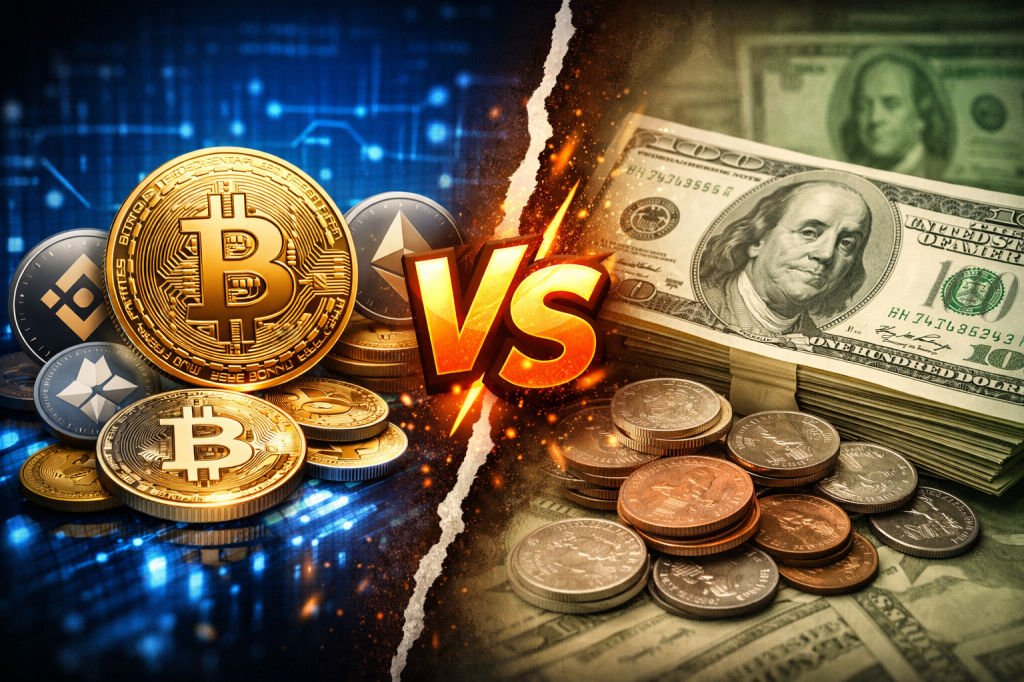
The idea of a cryptocurrency is very appealing concept because it offers a form of currency that is decentralized. This decentralization allows competition to determine the type of money that is utilized by the market. This means it will allow consumers to pick how their money is being managed rather than having all money controlled by the government. This movement has picked up a lot of traction in recent years due to high levels of inflation and the increased acceptance of cryptos. Inflation makes money less valuable, which hurts consumers. While the U.S. dollar and other world currencies have historically lost value, cryptocurrencies have gained value in recent years. Instead of holding U.S. currency, many investors are switching to cryptocurrencies. This raises the question, can crypto be used as money, and will it eventually replace government-backed currencies? No, crypto is not money, and it will never replace money as we think of it today.
For most people, crypto is nothing more than an investment. They do not have the widespread acceptance to be used for anything more than an investment tool or as money in some very limited circumstances (usually illegal). A 2019 article suggests that nearly 46% of all bitcoin transactions were utilized for illegal activity. This is staggering, but it makes sense because crypto can be liquidated to cash relatively easily, and it is harder to track because of the unregulated nature of crypto. While this article is old and ignores the cryptocurrency boom in the Covid-19 pandemic, it still signals an alarming trend. Fraud also runs rampant in cryptocurrencies, and this article talks about the prevalence of “pump and dump” schemes.
Ignoring the ethical standpoint of backing modes of currency that make illegal activity more feasible, crypto is not a viable form of money when viewed from an economics point of view. According to N. Gregory Mankiw1, professor of economics at Harvard University, money serves three key purposes: a store of value, a unit of account, and a medium of exchange. Crypto does not accomplish the purpose of money, and it likely never will.
Store of Value:
Money must be a store of value. This means that it must hold value over time, and it cannot fluctuate erratically. U.S. currency is money and the value does fluctuate over time because the purchasing power today is less than it was a year ago. This is due to inflation. However, the value of U.S. currency stays fairly constant over time with yearly inflation only around 3% currently. Bitcoin, the largest crypto, has had a lot more fluctuation this past year. The difference in price from the high to the low was around 51% in 2025 for Bitcoin, which is one of the most stable cryptos. Because crypto is not a reliable store of value, people cannot hold it to spend at a future date. Individuals getting paid in crypto will have to exchange it into money that can hold value if they plan to use it later.
Unit of Account:
A unit of account just means that money can be used for accounting functions, such as recording debt, measuring wealth, and assigning values to goods and services. When you or a company takes out debt, that debt is tracked in U.S. Dollars. Additionally, wealth is tracked in dollars. All of the metrics of an economy are measured in dollars. There is no crypto being used as a unit of accounting on a large basis. Most investors are more concerned with their crypto exchange rate with dollars than they are with utilizing crypto as a standalone unit of account. It would be nearly impossible to change the economy’s U.S. dollar system for measuring debts and wealth to a crypto backed system.
Medium of Exchange:
Some cryptos can be used in limited circumstances as a unit of exchange, but it is very limited. Most retailers will not accept payments in crypto due to it not holding a steady value, making it hard to be used to price their items. Crypto could easily be translated into a spendable currency through a debit or credit type of card, but it has not been done because the market does not want to accept these forms of currency as money. Exchanging crypto for other cryptos is one of the most prevalent ways crypto gets used as a medium of exchange. The U.S. dollar accomplishes the function of facilitating exchanges already, and there is very little reason to switch to another system while this is still widely accepted.
Will Crypto ever be Money?
Likely not. It would be interesting to see a new not government-backed form of money; however, it almost certainly will never happen. Checks and balances are much harder to enforce on a cryptocurrency, and the space is already filled with fraud. The United States and other countries have been using government issued money for millennia, and cryptocurrencies are still extremely new. I am not trying to be a skeptic and say that new is always bad, but cryptocurrencies are a product that does not solve a problem. If they do not solve a problem in the current system, they do not bring value. A large argument for crypto is that many of them have built-in scarcity. This means that nobody (not even the government) can cause inflation by just printing more cryptocurrency. Going into why the United States and other countries switched from a scarcity-based model of money is out of scope of this topic, but this has been tried and it did not work. Governments do not want cryptocurrencies to replace their money, so they can also go back to a gold standard or other model of money if they needed to. Because of the already widespread acceptance of government-issued money, they have considerable market power. Cryptocurrencies trying to steal market share of the money market are facing a government monopoly on money. No anti-trust laws are going to help keep the money market competitive, so there is nothing cryptos can do if the government decided tomorrow to make them completely obsolete.
The rise in popularity of cryptos in recent years is largely due to the fact that they have increased in value astronomically in recent years. The potential for high returns is incredibly persuasive for investors to join the space. This is who is currently holding and utilizing cryptocurrencies – investors. This is not money; it is only a niche investment that has gained popularity in recent years. At best, cryptocurrencies might stick around as a commodity that can be invested in like precious metals due to the scarcity. Because of the higher propensity for fraudulent activities with cryptos and the increased risk of decentralized currency, I would hesitate before investing large sums of money into this market.
1 Source was from Macroeconomics 11th edition (2022) published by Worth Publishers





Leave a comment