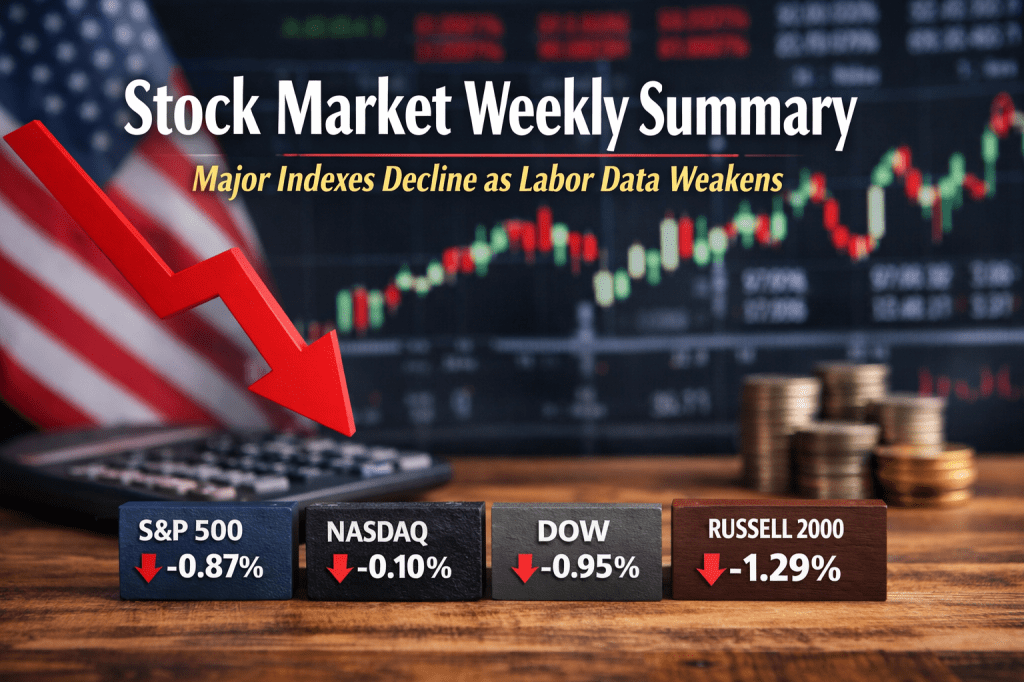
The U.S. stock market had some shifts this week, but the overall market stayed relatively static. Here is a summary of some of the major indexes and how they performed this past week:
- S&P 500 Index – decreased 0.87%
- Nasdaq Composite – decreased 0.1%
- Dow Jones Industrial Average Index – decreased 0.95%
- Russell 2000 Index – decreased 1.29%
This shows that the overall market was down this past week. However, these decreases are not too significant. The Bureau of Labor Statistics did release economic data this past week for unemployment rates and inflation. Unemployment rates did worsen again following the trend in recent months, but inflation lightened. Inflation data will not have as much of an effect on stock prices because inflation tends to hurt consumers more than businesses. Worsening unemployment does show that the economy is not performing at optimal levels, so this did have an impact on the stock market’s performance.
The beginning of the week saw stocks dip in anticipation of weaker labor market numbers from the report on Tuesday. The impact would have been more drastic if labor market number were expected to be more positive. Still, many stocks decreased slightly after the higher unemployment numbers were released on Tuesday. Then, after less than expected inflation was reported, a lot of stocks saw mild gains throughout the rest of the week. The market still ended lower than the week prior because these unemployment figures are going to be a sign of potentially less economic output.
Industry Changes
Pharmaceuticals: The Pharmaceuticals industry, tracked using Dow Jones’ U.S. Pharmaceuticals Index (DJUSPR), increased 1.26% last week. This index is made up of fairly resistant stocks from economic conditions, so the higher unemployment rate did not have too negative of an effect on these stocks. This industry index increased on Monday then lost a lot of ground on Tuesday after the unemployment report was published. These stocks have been benefitting from increased investor confidence in future returns, so this industry was poised for growth this week. While this industry is not as hurt by negative economic conditions as other industries, it is still strained, so stocks did not go up as much as they otherwise would have.
Financial Services: The Financial Services industry, tracked using Dow Jones’ U.S. Financial Services Index (DJUSFV), decreased 0.47% last week. These stocks did fall on Tuesday like the rest of the market, but Wednesday morning actually brought about a short-lived rally for the stocks. Then again there was another short-lived rally after the inflation numbers were announced. These rallies did not last long however, and the industry still ended down for the week. The fluctuations were in part due to economic conditions, but also due to investor forecasts for the stocks in 2026. JP Morgan is projecting higher costs in 2026, and the financial services industry is also highly invested in economic growth from sectors such as AI. Worsening unemployment and higher costs could be problematic if AI investments fall short. However, this industry has shown profitability and resilience in recent years, so this industry is still in a strong position.
Technology: The Technology industry, tracked using Dow Jones’ US Technology Index (DJUSTC), decreased 0.21% this week. The economic data this week was actually better than expected. Decreasing inflation means that unemployment is going to be more of a concern for the Federal Reserve moving forward. This means that there will likely be more interest rate cuts soon. The technology industry is more benefitted by lower interest rates than many other industries because of this industry’s reliance on debt to fund growth. However, there are still investor concerns about the profitability of AI companies because of their low earnings compared to high costs to operate and develop. All these factors coupled together made the industry relatively stable this past week. Future growth will depend on a healthy economy and lower interest rates.
Consumer Goods: The Consumer Goods industry, tracked using Dow Jones’ US Consumer Goods Index (DJUSNC), increased 0.14% this week. This is one industry that did not see a decrease with the unemployment data released on Tuesday. This could be because investors in this industry are counting on lower interest rates from the Federal Reserve to be more reinforced by this data. Additionally, a large part of this index is also consumer staples, which are more resilient to worsening economic conditions. While increasing unemployment will cause decreasing discretionary spending, this industry may be less impacted due to some consumer goods that will not be easily substituted. This industry can be more resilient than technology or other industries that are highly dependent on discretionary spending. Many investors may be looking for a more stable place to invest, and the consumer goods industry is fairly stable despite lower returns.
Oil & Gas: The Oil & Gas industry, tracked using Dow Jones US Oil & Gas Index (DJUSEN), decreased 2.82% this week. Oil prices decreased this week, so this industry was very negatively impacted. Worsening unemployment also impacts this industry because oil can be used in the manufacturing of many other items such as plastics. Worsening economic conditions will impact Oil & Gas. However, gasoline sales are fairly resistant to worsening economic conditions because gas is a necessity for many people’s ways of life. This index is almost certainly down because oil prices continue to fall, which is greatly hurting the profitability of individual stocks.
Parting Thoughts
The changes in the market this week were very mild, but still negative across major indexes across the economy. This indicates that there is less investor optimism going into 2026. This week showed that the more recession resilient industries are poised for growth. Worsening unemployment will have negative impacts across the entire economy. Hopefully unemployment is lessened by the Federal Reserve’s interest rate cut decision on December 10th. There will be one more round of BLS economic reports before the next time the Federal Reserve meets to decide interest rates, so it is unknown yet if there will be a rate cut in late January.
Going into Christmas next week, it will be interesting to see how consumer spending this year compares to previous holiday seasons. Black Friday 2025 growth indicates that this holiday season could bring about a lot of growth which would reassure investors on the viability of the economy. Consumer sentiment seems to be very negative over the entire economy, but actual economic data does not seem to back this up. Looking at consumer reports for the holiday season will show if household economic conditions are actually worsening. Debt is still very expensive compared to the rest of the 21st century, so high levels of debt propping up the economy seems more unlikely. If this was the case, it would have to be household debt, which can be harder to manage than business debt. Overall, it was a fairly neutral week in the stock market despite an overall minor loss.





Leave a comment