Understanding the economy is important because its health has direct impacts on you. Available jobs are a result of the economy. Without a stable currency, purchasing items would be very chaotic. Necessities like food and water are provided because the economy supports those functions. Because of the vast importance of the economy, policymakers focus on economic metrics to describe the effectiveness of their policies or other’s inefficiencies. Understanding these measures allows stakeholders to be better informed when making decisions about what policies to support. These metrics also show the reasoning behind economic impacts in daily life.
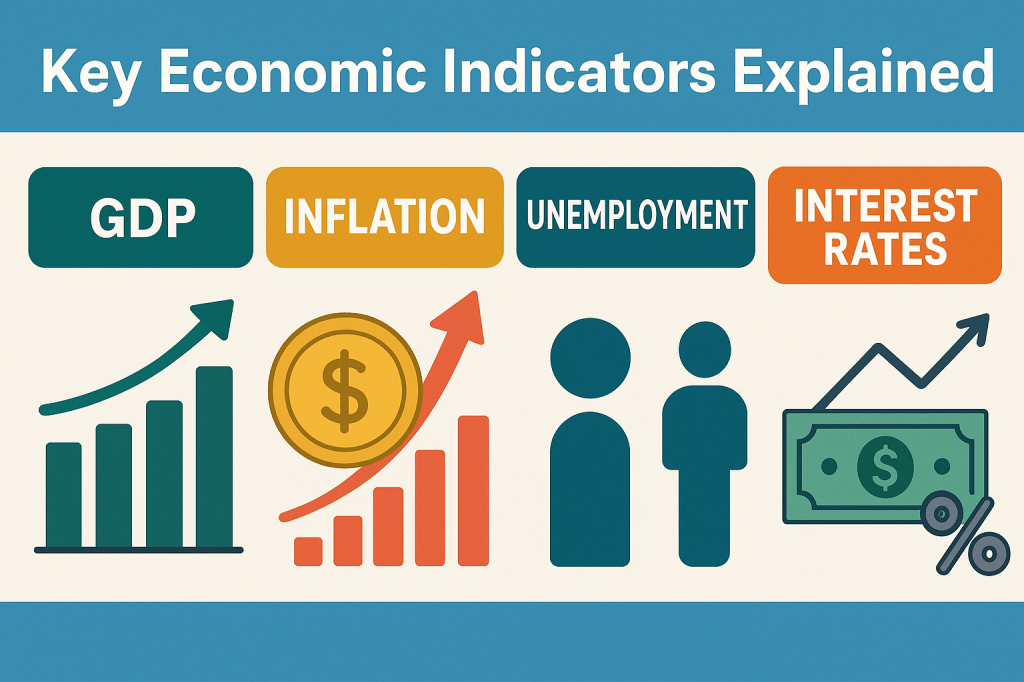
There are many economic metrics that can be used to assess the health of the market. These are macroeconomic metrics because they are able to show a better picture of the economy as a whole. The key metrics to focus on are the economy’s Gross Domestic Product, Inflation Rate, Unemployment Rate, and Interest Rates.
Gross Domestic Product (GDP)
This is the measure of output in the economy. The GDP of a country is the summation of four key components: Consumption, Investment, Government Purchases, and Net Exports. Each of these is very important, and raising any one of these components is able to make a meaningful difference in the overall GDP.
- Consumption: This is defined as the money spent by individuals for goods and services. If you or another person spends money on something, this is almost always consumption. When a consumer spends money, they receive some value from what they purchased. In this way, GDP can also be a measure of value in the economy. Consumers also spend money on intangible services like insurance. Consumption is the largest contribution to the U.S. economy’s GDP. When anyone spends money on an item or a service, this increases consumption. Consumption is about 68% of the U.S. GDP.
- Investment: Investment occurs when money is put aside for something in the future. This is typically broken down into two types: residential investment and non-residential investment. The key difference is that non-residential investment is when an organization spends money on something that will benefit them in the future. This could be new equipment, facilities, etc. Residential investment is just the measure of new housing being purchased. The combination of these investment types accounts for around 18% of the U.S. GDP. However, GDP is not transferring money. Someone investing in the stock market is just transferring their money. That transfer does not get added to GDP because it is not increasing output.
- Government Purchases: These are goods and services bought by the government. This can be from the government spending money on the military, transportation, parks, highways, etc. This makes up around 17% of the U.S. GDP.
- Net Exports: This is the difference between what is exported and what was imported. If something that the U.S. Economy produced was exported, that will still count towards the U.S. GDP. Consumption does not differentiate between what was spent on domestic products or foreign goods. Because of this, all imports have to be subtracted from the GDP because they were not actually produced by the U.S. economy. The U.S. has a trade deficit of around 3% of the total GDP. This means the U.S. imports more than it exports.
Simply put, Consumption is what consumers spend their money on, Investment is what businesses spend money on, and Government Purchases is what the government spends money on. Intermediary transactions are not counted in the calculation of GDP. This means if money was spent on something that went into producing something else, it will not be counted. For example, a business paying wages to line workers manufacturing an airplane will only have the value of the airplane added to the GDP. The wages of the manufacturing workers will not be added to GDP because that is an intermediate service. Counting both would be double-counting output.
The GDP shows how much value has been created by an economy. The higher the GDP, the more output. GDP per capita is a measure of total GDP divided by the population. The U.S. GDP per capita was $80,706 (7th highest globally) in 2023. This is really a metric of how much value was created on average for every individual within the economy.
Inflation Rate
The Inflation rate is a measure of how much prices increase. This is important because GDP can increase, and people could still be worse off. This is because prices rising will make GDP appear higher without increasing the output in the economy. Consumption is dictated by how much is spent by households, so, if households have to spend more for less overall value, they will be worse off. This is why GDP can also be measured as real GDP. Real GDP accounts for rising prices resulting from inflation, and it allows real economic growth to be measured. This is done by choosing a base year to compare with the current year’s GDP. There has to be a shared price metric between the base year and the current year to compare what the inflation rate was between the two. The most common way to measure inflation is utilizing the Consumer Price Index (CPI). This is done by the Bureau of Labor Statistics which takes price data on many commonly purchased items across several industries. The BLS then will utilize those prices to see how much they increased over time. This inflation rate (found by using the CPI) is utilized to measure if GDP growth is resulting from more output or from rising prices. A 5% GDP increase with a 3% inflation rate shows that real GDP increased by 2%.
The purchasing power of money decreases over time because of inflation. This is why it is not ordinarily good financial advice to hold onto money for a long period of time. Inflation of 3% annually will reduce the purchase power of money by 50% in roughly 24 years. However, inflation is not necessarily a bad thing. If inflation impacts all things equally, wages should also rise to meet the rising inflation. This is why slow inflation is not widely felt by most consumers. Fast inflation when wages do not keep up can be very detrimental to a society as consumers get priced out of their ordinary purchases.
Unemployment Rate
The unemployment rate is a measure of how many people who want to work cannot find employment. Those who cannot work or choose not to work are not included in the unemployment rate. Only individuals who are actively applying for positions and are unable to secure employment are counted for in unemployment metrics. This metric is especially important because it shows how much labor is being underutilized in the economy.
Reducing unemployment is a key policy point for many local, state, and federal politicians, and it is something that is not easily achieved. When unemployment is low, GDP rises faster and overall quality of life increases. This is why so many policies and programs are specifically intended to decrease unemployment rates. Ordinarily, unemployment naturally decreases when the economy is going through periods of growth. On the other hand, unemployment tends to increase when the economy is facing harder times. This is why the market responds so drastically to changes in the unemployment rate. The rate is often a key indicator if the economy is expanding or shrinking.
Interest Rates
Interest rates are the cost to borrow money in an economy. This is highly important because growth is oftentimes funded utilizing debt. The Federal Reserve manages inflation and unemployment utilizing their ability to influence interest rates in the economy. Low interest rates increase economic output because growth is more affordable. High interest rates slow down inflation because borrowing money becomes more expensive. As debt is more expensive, the amount of debt goes down. This makes the amount of money spent in the economy go down, lowering inflation. If consumers and businesses can borrow of a lot of money for a very little cost, inflation will skyrocket due to the amount of money spent in the market. This is why keeping interest rates at a strategic level is vitally important, and it is the responsibility of the Federal Open Market Committee.
Interest rates can factor in inflation utilizing the real interest rate just like with GDP and real GDP. An interest rate of 6% with an inflation rate of 3% will have a real interest rate of 3%. This means that money loaned at 6% annually will only be able to purchase 3% more in a year from now if the debt is paid back. A lot of home loans have a fixed interest rate. If a home loan was signed at a 3.5% interest rate when inflation was 2%, the lender was expecting a real return of 1.5% annually. However, inflation has drastically increased from 2% in recent years, so, in terms of real purchasing power, lenders were losing money at a 3.5% interest rate. Increasing inflation can hit lenders very hard if the rates of the loans are fixed.
Takeaway: While some of these metrics affect populations of the economy differently, everyone is impacted by the health of the economy. These metrics are not all encompassing of everything that determines the health of the economy, but these are the most widely used by stakeholders.





Leave a comment