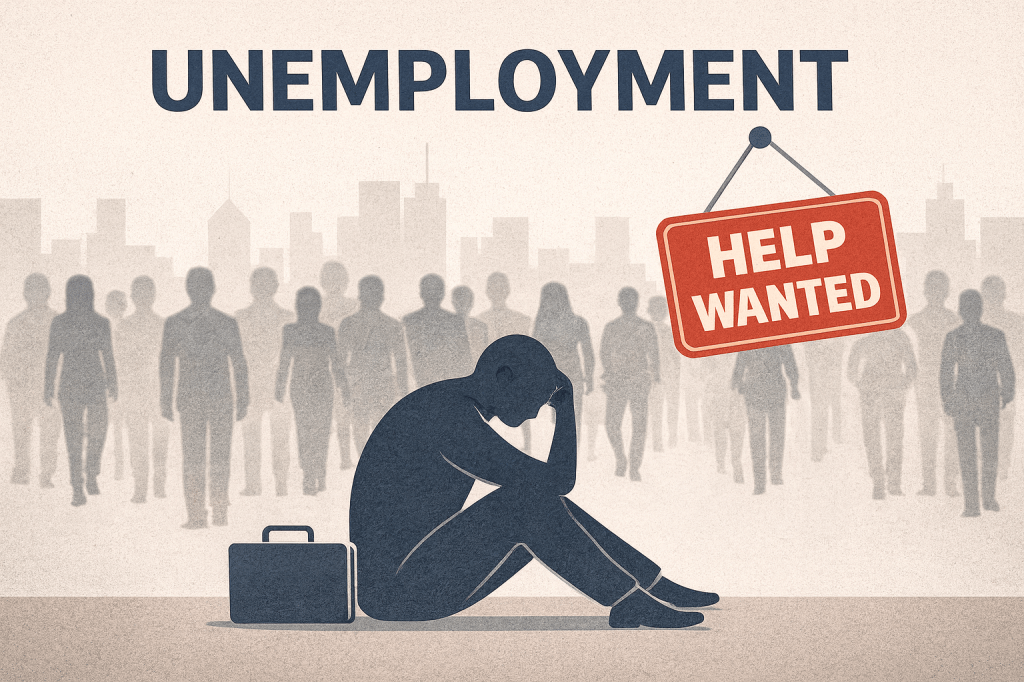
Unemployment is a key metric that economists look at when assessing the health of an economy. This is because economic output is driven primarily by labor and capital. When people want to work but cannot, labor is being underutilized in the economy. This yields less overall economic output, and it hurts the entire economy. There are four key types of unemployment listed below.
Frictional – Frictional Unemployment is a normal type of unemployment that arises when an employee seeks a new job or an employer needs to fill a new position. There is also some frictional unemployment when someone enters the labor market. This type of unemployment is usually short because it does not take much time to fill a needed position if there are workers available. Also, a few weeks of unemployment is predictable when leaving one position for another. Applying and interviewing can take some time, but this type of unemployment is only temporary. Frictional unemployment can be easy to remedy, and it is not a major economic concern. Services can be provided to help individuals learn about open positions, and this can greatly reduce frictional unemployment. Frictional unemployment occurs because it takes some time to ensure employees and employers are a good match before hiring.
Seasonal – These are predictable unemployment spells resulting from a regular market change. An example of this would be a water park laying off its workforce after the summer. Some markets are highly dependent on labor for certain seasons while they do not need that labor in slow seasons. A market like Martha’s Vineyard in Massachusetts utilizes significantly more labor in tourism seasons than in off seasons. This type of unemployment is predictable, and it is not a major economic concern. When people get laid off in the off-season, they will have some frictional unemployment before they get a new position. This is healthy in an economy because it means the labor force is responding to market conditions.
Structural – Structural unemployment is where economists start to grow concerned. Structural unemployment happens when workers wanting to work cannot find jobs because they are unqualified for open positions. Positions are available, but unemployed workers cannot fill those roles. Some industries are growing while others are shrinking. An employee from a shrinking industry may not be able to transfer over to a growing industry. Despite a job being available and a worker available, there will still be unemployment because that worker cannot fill the role. A modern example is that the AI technology space is rapidly growing while paper mills are on the decline. The AI industry may need additional labor to support the growth, but workers laid off paper mills cannot fill AI job positions. This example illustrates the core of structural unemployment. The labor force in certain areas is shrinking, and those laborers are unable to transfer to a new industry. This type of unemployment is such a concern because it has the tendency to be longer-lasting. If a laid-off skilled worker cannot find a job in another industry, they will have to learn new skills to become hirable again. Policies aimed at providing training programs for workers or incentives to increase a person’s skills are utilized to try to combat structural unemployment.
Cyclical – Cyclical unemployment is also a concerning type of unemployment for economists and policymakers. This is where there is an imbalance between the number of people seeking employment and the number of jobs available. Cyclical unemployment is so concerning because no matter what skills the labor force may possess, there are not enough jobs to go around. This occurs when there is an economic slowdown like a recession. Organizations have to cut back on production during recessions. This means that labor demand goes down while labor supply stays constant. When demand for labor goes down due to circumstances outside a firm’s control, like a recession, firms are faced with two options: decrease wages or lay off employees. Wages tend to be very hard to decrease since employees are never happy when they get told they will be paid less for the same work. This is why most organizations are forced to keep wages steady and lay off employees. When this happens, a surplus of labor supply will occur in the market. This surplus is cyclical unemployment. Until wages can be brought down to equilibrium levels or the demand for labor increases, there will be cyclical unemployment. The government tends to solve cyclical unemployment by increasing the demand for labor. They do this by encouraging businesses to grow by lowering the interest rates.
Which Type is the Most Impactful?
Frictional unemployment is usually very short-term. By nature, it should end fast as workers are able to apply for open roles in which they are qualified. Seasonal unemployment is also not really a concern. Seasonal unemployment is predictable, and those laborers know in advance that their employment is temporary. There is no real incentive to enact economic policies to try to decrease seasonal unemployment. It is normal and predictable; workers are able to plan around this time. If seasonal unemployment stretches too long, it becomes structural or cyclical unemployment because there are other market conditions at play than just seasonal shifts.
Economic concerns arise if unemployed workers are underqualified or there are no open roles at all. An abundance of underqualified laborers is an example of structural unemployment. This can take years to solve. Oftentimes, further education or new skill sets need to be developed for workers to be able to take on jobs in new industries. Some skills are just not valuable anymore in the economy, and this makes structural unemployment so hard to solve. Workers who are unemployed due to structural reasons will either have to take jobs at a skill level they currently possess or develop new skills. Developing new skills is costly and time consuming. A worker needing a wage may have to take a pay cut and work an unskilled job. An example would be a highly skilled paper mill worker has to work an unskilled labor position making significantly less. Workers tend to continue to apply for jobs with their old skillset and wage level for a significant period of time. This can cause structural unemployment to be long-lasting and particularly disheartening if old skills are now unvalued and old wages are unattainable.
When there are not enough jobs to fit the labor force, this is a cyclical unemployment concern. As mentioned before, the only real solution for cyclical unemployment is to increase the demand for labor. This means that the government will need to step to solve the reason behind the decreased demand for labor. To combat a recession, the government can use Keynesian Economic policies like increasing federal employment or providing stimulus checks. The government can also lower interest rates to make growth more affordable for businesses. Higher growth will lead to more employment which can help to solve the cyclical unemployment problems.
So, which is worse, structural or cyclical unemployment? I believe the answer is that structural unemployment is worse. Cyclical unemployment is really hard on a lot of people when it occurs, but it only occurs when the entire economy slows down. Recessions are pretty rare, and economic growth is far more common than economic decline. Structural unemployment is more prevalent and consistent. Currently, there are available positions in the economy, yet the unemployment rate is 4.4%. While some of this is short-term frictional unemployment, the rest is long-term structural unemployment. The labor market sentiment is at a low right now. This is due to increasing difficulties for workers to find employment. This is not because there are not jobs available, it is because there are not jobs available in industries that are experiencing unemployment. The long-term solution is that these industries either need to grow or laborers are going to have to find new industries to work. There are a lot of declining industries due to AI expansion and changes in consumer preferences. Solving structural unemployment has always been a challenge, and it will continue to be a challenge for years to come.





Leave a comment